Simplifying scholarship applications through a structured, transparent, and student-first experience.
Timeline
5 Weeks
Tool Used
Figma, Chat GPT
Project Type
Solo Project
Introduction
UWH (United Way Hyderabad) runs sponsored scholarship programs for students.
They needed a digital platform where scholarships could be posted, students could apply online, and the entire selection process could be managed in one place.
This project was designed from scratch based on the client’s workflow.
The process included registration, document submission, screening, scoring, shortlisting, and final selection, which made the system complex for both students and admins.
My role was to design the complete experience including:
Student journey
Admin workflow
Dashboard & tracking
Multi-step application flow
The challenge was to keep the experience simple while supporting a complex process.
The scholarship process has many stages, so the goal was to design a flow that feels easy for students while still supporting the organization’s full selection workflow.
Students should be able to:
Browse scholarships
Complete profile step-by-step
Apply without confusion
Track application status
Admins should be able to:
Create scholarships
Define rules & scoring
Review applications
Control each stage
The goal was not just clean UI, but a structured workflow that makes a complex system easy to use.
While working on the flow, I realized the scholarship system is not just a form.
It includes multiple stages like registration, screening, scoring, document verification, and interview rounds.
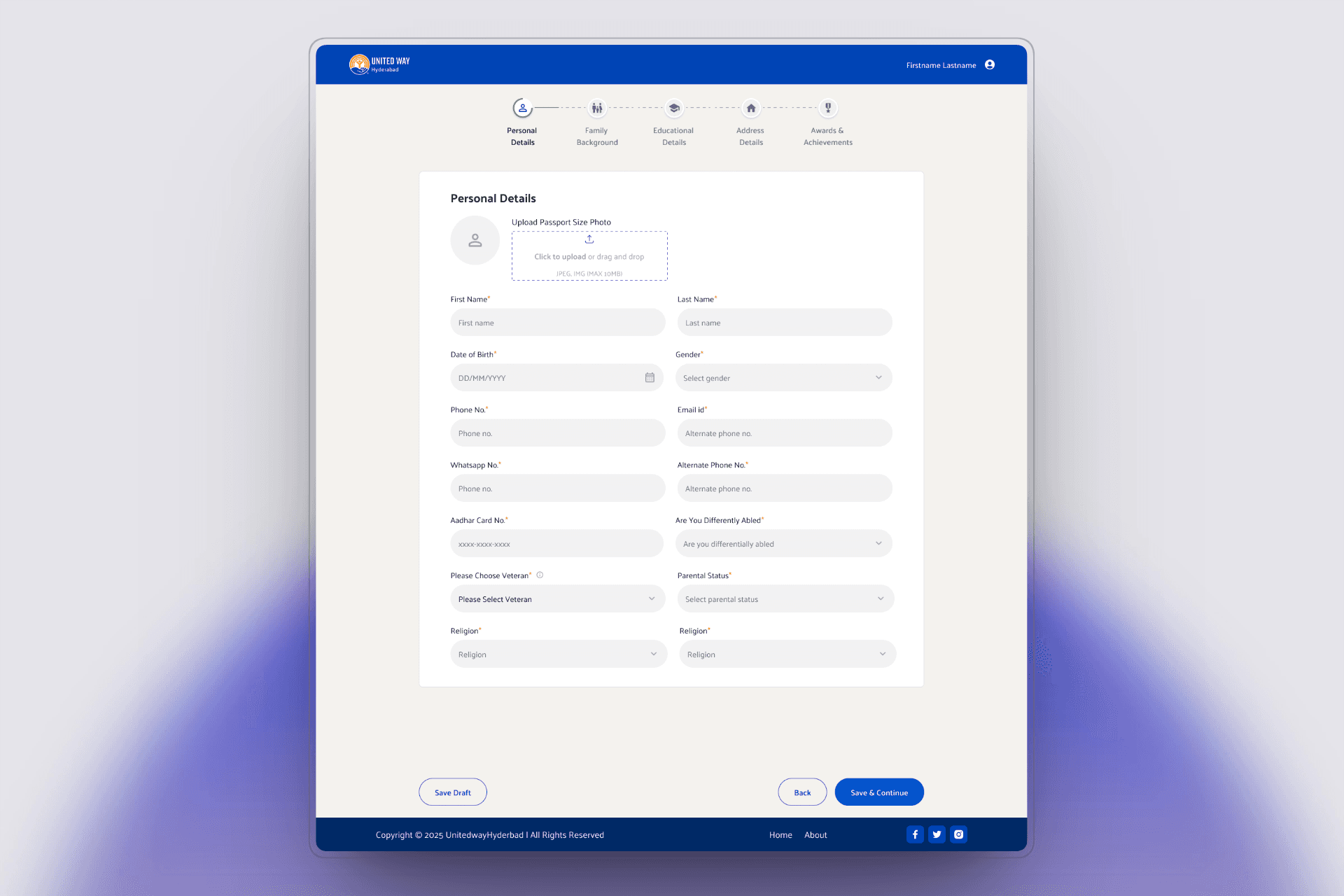
For students, the journey starts with onboarding, where they enter personal, academic, and family details.
This information is later used to evaluate eligibility, so onboarding needed to be detailed but still easy to complete.
For admins, the process is more complex.
Each scholarship has different rules, so the system needed scoring logic instead of manual checking.
Another key insight was that selection happens in stages, not all at once.
Students move forward only if they meet the criteria, so the flow needed to support step-by-step progression.
This meant the design had to focus on workflow logic, not just UI screens.
Designing this system was challenging because it involved a long and detailed process.
From student side
Too many onboarding questions
Large forms feel overwhelming
Hard to understand progress
Uploading documents is confusing
No clarity on selection stages
From admin side
Manual screening takes too long
Different scholarships need different rules
Hard to track applications
Selection process not structured
Difficult to manage multiple stages
Another challenge was that the organization wanted custom rules for each scholarship, which required a flexible system.
Because of this, the design needed to support automation, scoring, and stage-based selection.
Instead of designing screens first, I started with the workflow structure.
I mapped the full journey for both students and admins, then divided the process into smaller steps to avoid confusion.
For students:
Step-by-step onboarding
Scholarship listing
Application flow
Status tracking
For admins:
Scholarship creation
Rule setup
Screening & scoring
Multi-stage selection
The onboarding flow was divided into multiple steps so users could complete it without feeling overwhelmed.
For the admin side, scholarship creation was designed in stages:
Basic details
Screening rules
Scoring setup
This allowed the system to automatically evaluate applications in the first round.
Later stages included:
Document verification
Interview round
Final selection
The goal was to make the system flexible for admins but simple for students.
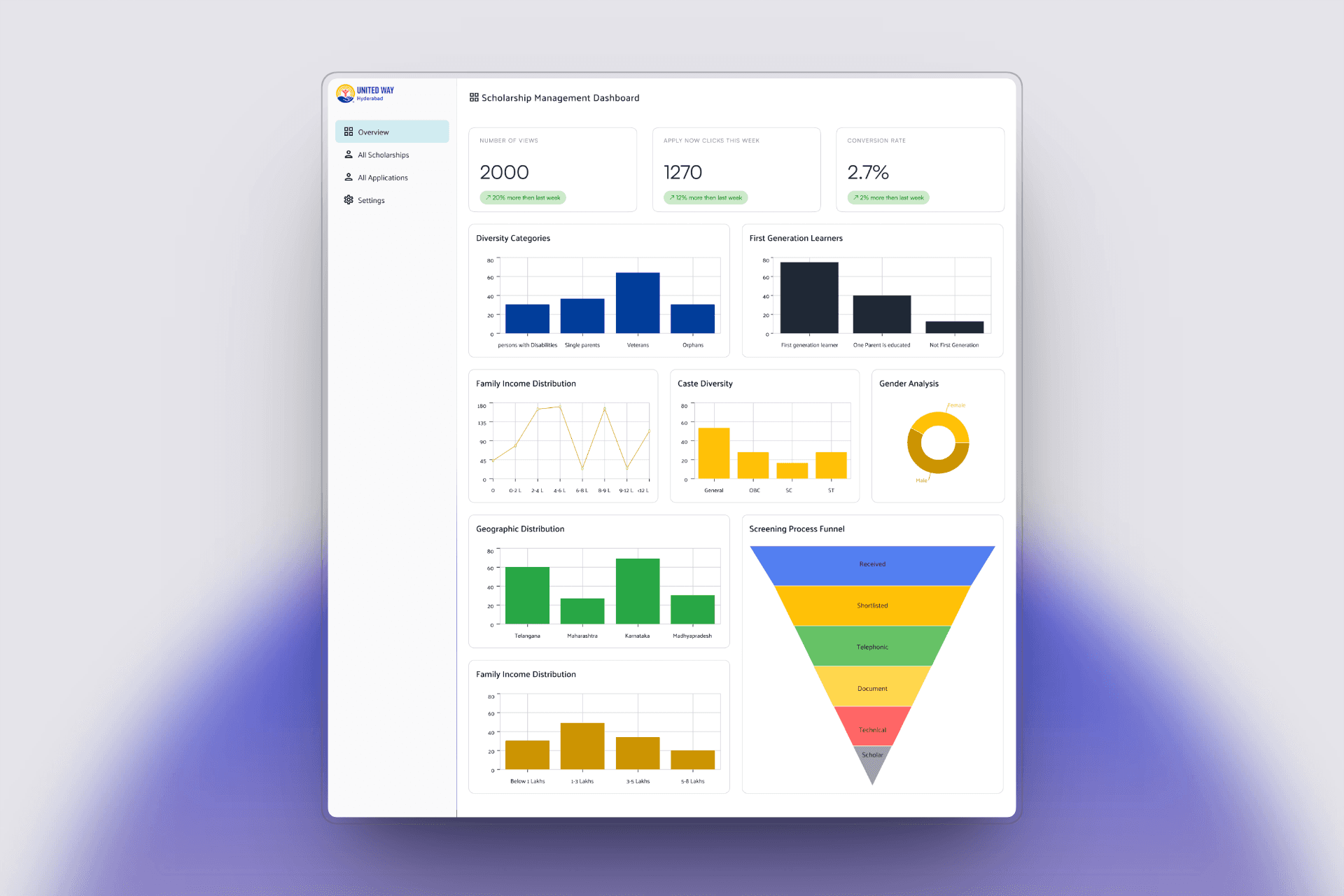
The final design is a complete scholarship platform that supports a full stage-based selection process.
Students can register, complete onboarding, apply for scholarships, and track their progress from the dashboard. Breaking the process into steps made it easier to handle large forms without confusing the user.
Admins can create scholarships, define rubrics, set qualifying scores, and move applications through different stages. The scoring-based screening reduces manual work and keeps the workflow organized.
The final solution matches the client’s real process while keeping the experience structured, clear, and easy to follow.
This project taught me how important workflow design is when building systems with multiple stages and different types of users. Instead of focusing only on UI, I had to think about how the process should work from start to end.
Designing onboarding forms, scoring-based screening, and stage-driven selection helped me understand how complex systems can be made easier through structure and clear flow.
Working on a real client requirement improved my ability to design practical products where decisions are based on workflow, not just visuals.